Lab note
Salt-Free Water Softeners: Do They Work?
Salt-free “softeners” don’t soften water. They leave the calcium and magnesium in; at best they change how that hardness behaves so less of it sticks as scale. Nebraska Extension calls them “descalant devices as opposed to hardness removing devices, since they do not remove the hardness from the water.” Whether a unit prevents scale in your house is the open question: the same guide (December 2025) says “few conclusive studies confirm the efficiency of these devices for residential use.” A U.S. test standard for scale-reduction claims, IAPMO/ANSI Z601, was published in 2018, so the useful question to ask a seller is whether their model passed it.
What salt-free conditioners do to hardness minerals
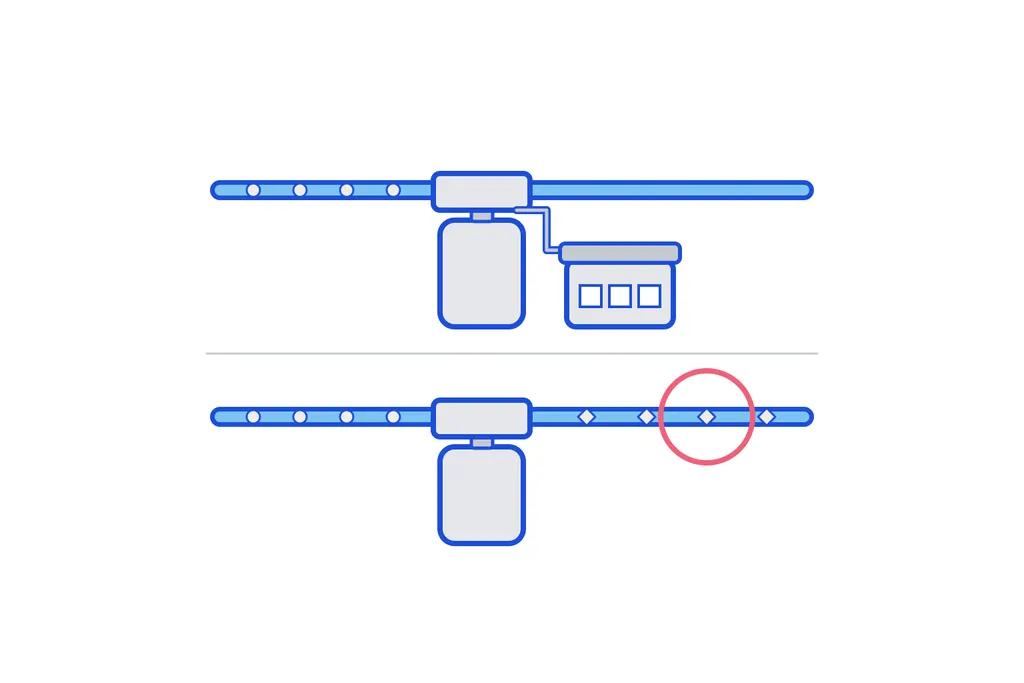
A softener (ion exchange) trades calcium and magnesium for sodium or potassium. A salt-free conditioner doesn’t take them out. The Water Quality Association (WQA) says these technologies “may provide a measurable reduction in hardness depending on the measurement method applied by conversion of calcium and magnesium ions to a precipitate form, but do not provide a reduction of total calcium or magnesium content of the treated stream nor are they proven to achieve soft water (less than 1.0 grain per gallon/<17.1 milligrams per liter or parts per million of total hardness).”
So a hardness test after a salt-free unit may read the same as before, or lower depending on the method, but the calcium and magnesium are still there.
| Salt-based softener | Salt-free conditioner | |
|---|---|---|
| Hardness minerals | Removed (exchanged for sodium or potassium) | Stay in the water, in a changed form (for TAC) |
| Soft water (under 1 gpg) | Yes | WQA: not “proven to achieve soft water” |
| Salt, brine, regeneration water | Yes — Penn State estimates “about 50 gallons” per regeneration | No |
| Test standard for performance | NSF/ANSI 44 (hardness reduction, capacity) | IAPMO/ANSI Z601 (scale reduction) |
Types: TAC, sacrificial media, magnetic and electrochemical
- Template-assisted crystallization (TAC) “uses surface-treated resin beads to convert (not remove) dissolved hardness ions to microscopic scale-resistant crystals” (Nebraska Extension). Nebraska adds that “a fine dust may form on dishes but it can be wiped away” and that TAC units “typically require relatively clean water,” with pretreatment for “high iron and manganese concentrations or other sediment.”
- Sacrificial media. WQA: such a device “releases a chemical such as citric acid or phosphate into the water to discourage the formation of scale.”
- Magnetic and electromagnetic devices. Nebraska Extension: “should be regarded as unproven technology without a strong scientific basis.”
- Electrochemical (capacitive deionization) is one type that does lower hardness: Nebraska says these systems reach “less than 5 grains per gallon,” but “have difficulty in achieving soft water with less than 1 grain per gallon.”
For the unit alone, Fixr (Jan 2025) lists “descaler” systems at $200–$2,000 and ion-exchange softeners at $500–$2,000; Penn State Extension puts softener hardware at “around $500-$1500.” Installed costs: water softener cost.
When salt-free can be enough
It can make sense when you want less scale, not soft water, and your water fits the unit’s limits:
- Hardness is moderate. Fixr says descalers are “not usually recommended for those who have very hard water.” Check yours on the water hardness scale.
- The water is clean going in. For TAC, Nebraska Extension calls for pretreatment of iron, manganese and sediment. The Tier1 12 gpm TAC conditioner sold by DiscountFilterStore, for example, states its rated life applies “when incoming water has less than 0.5ppm chlorine, 0.3ppm iron, 1.3ppm copper, & pH of 6.5-8.5,” and adds: “(System does not reduce TDS or soften water.)”
- You want to avoid salt, sodium or brine discharge. The Minnesota Department of Health notes that a salt-based softener “increases the amount of sodium in the water you drink at home” and that Minnesota “has a growing problem with chloride in water.” Writing about the new standard, IAPMO’s Tom Palkon noted that some areas of the U.S. had banned cation exchange softeners. If sodium is a concern for someone in your home, ask your doctor.
When you need a real softener
If you want soft water, note that Nebraska Extension found “no independent studies confirm which technologies address poor soap and detergent performance.” And if hardness, iron or manganese must actually come out, “treatment other than salt-free water softening alternatives must be used.” To size one, see what size water softener do I need.
How to check performance claims and certifications
NSF/ANSI 44 doesn’t cover salt-free units. It is the standard for softeners that use “a cation exchange resin” (NSF). Writing in Water Conditioning & Purification in 2014, NSF’s Rick Andrew said other scale-control technologies “are not cation exchange. And as such, there has not been any American national standard for evaluating them.”
IAPMO/ANSI Z601 is the U.S. scale-reduction test. IAPMO published it in July 2018. Per IAPMO’s Tom Palkon, it compares scale from 26-gpg water in water heaters with and without the device over at least 10 days. Devices “are required to reduce the scale by at least 70% to pass.” Check two details on any claim:
- Water heater type. A device tested at 8 W/cm² is “deemed adequate for gas-fired tank-type water heaters”; one tested at 30 W/cm² for “all tank-type water heaters.” Tankless heaters have a separate protocol.
- Edition. Rick Andrew’s 2014 column, describing the draft, gave an 80% threshold; Palkon’s account of the published 2018 edition says 70%. As of August 2025, IAPMO listed a Z601 revision in ANSI public review. Ask which edition the test report refers to.
Nebraska Extension’s December 2025 guide, for its part, says standards for no-salt devices “are being developed,” and that until product testing is available “consumers cannot tell for certain which products best reduce scale buildup in the home.”
Older German test. DVGW W 512 (1996, now withdrawn) required “an 80-percent reduction of scale formation,” per Rick Andrew. DIN Media recommends DIN 3607-2:2023-05 “in lieu of the withdrawn document DVGW W 512:1996-09, for which no replacement is available.”
An NSF/ANSI 42 or 61 mark alone doesn’t prove scale reduction. NSF’s list of NSF/ANSI 42 claims — chlorine, taste and odor, particulate, iron and others — has no scale claim, and Z601 uses 42 and 61 only for its material-safety and structural-integrity requirements. WQA’s advice: look for antiscaling systems “demonstrated to meet performance, structural integrity and safety according to a published standard by an accredited third-party product certifier.”
Read the seller’s numbers. The Tier1 listing above names TAC but no scale-reduction standard. It gives the media life as “900,000 gallons or 8-9 years” in one place and “approximately 3 years or around 600,000 gallons” in its FAQ. It is listed at $675.99, on sale for $549.99 (checked Nov 1, 2026; no end date shown).
Questions for the seller:
- Which standard did this exact model pass — Z601 (which edition) or DIN 3607-2 — which lab, and at what heater power density?
- What maximum hardness, iron, manganese, chlorine and pH does it allow?
- How many gallons or years before the media is replaced, and at what cost?
- Who installs it? A licensed plumber; ask whether your town requires a permit.
This site doesn’t give medical advice. For health questions about your water, ask your state or local health department. Not sure what your water needs? Start with the Water Check.
Tool
Have a hardness number or a well test? Water Check turns it into what to install, the size and a price range.
Open Water CheckAn AI tool drew the illustrations on this page as simple diagrams. They are not photographs of real homes, water systems, products or people.
Sources
- Nebraska Extension — G2275, Drinking Water Treatment: Salt-Free Water 'Softener' Options (Dvorak & Schuerman, Dec 2025), pp. 1–3
- Water Quality Association — Scale Deposits (modified Mar 20, 2023)
- NSF — NSF Standards for Water Treatment Systems (consumer page, accessed Nov 1, 2026)
- NSF — NSF/ANSI 42, 53 and 401: Filtration Systems Standards (Dec 16, 2025)
- Rick Andrew (NSF), A New Standard for Evaluation of Scale Control Equipment — Water Conditioning & Purification (Oct 14, 2014)
- Tom Palkon (IAPMO), Testing for Scale — WaterWorld (posted Jul 26, 2021), on IAPMO/ANSI Z601-2018
- IAPMO — American National Standards, Open Projects (as of Aug 12, 2025), p. 1
- DIN Media — DIN 3607-2:2023-05, Limescale protection devices… Part 2: testing of the effectiveness (recommended by DIN Media 'in lieu of' the withdrawn DVGW W 512:1996-09, 'for which no replacement is available')
- Penn State Extension — Water Softening (updated Sep 8, 2025)
- Minnesota Department of Health — Home Water Softening FAQ (last updated Oct 3, 2022)
- Fixr — Water Softener Installation Cost (updated Jan 31, 2025)
- Tier1 Salt-Free Whole House Water Conditioner, 12 GPM — listing on DiscountFilterStore (regular and sale price, checked Nov 1, 2026)
Updated 2026-11-01