Lab note
What Is Hard Water?
Hard water is water that carries a lot of dissolved calcium and magnesium. The U.S. Geological Survey puts it plainly: “The simple definition of water hardness is the amount of dissolved calcium and magnesium in the water.” You notice it as white scale on faucets and kettles, spots on glasses and soap that won’t lather well. Hardness is reported as calcium carbonate, in milligrams per liter (mg/L, the same as ppm) or grains per gallon (gpg). On the USGS scale, 0–60 mg/L is soft, 61–120 moderately hard, 121–180 hard, and more than 180 very hard.
Other sources draw the lines differently. Penn State Extension, for example, adds a “slightly hard” class and calls only water under 17 mg/L soft, so 45 mg/L is “soft” to USGS but “slightly hard” to Penn State. The Water Check uses the Penn State table. Both scales and the unit conversion are on the water hardness scale page.
Where hard water comes from
Hardness is picked up underground. USGS explains that “as water moves through soil and rock it dissolves small amounts of naturally-occurring minerals and carries them into the groundwater supply,” and that if calcium and magnesium are in the soil around a well, hard water may be delivered to homes. Penn State’s water-testing lab describes hardness as “Naturally occurring in many areas, especially where limestone occurs.”
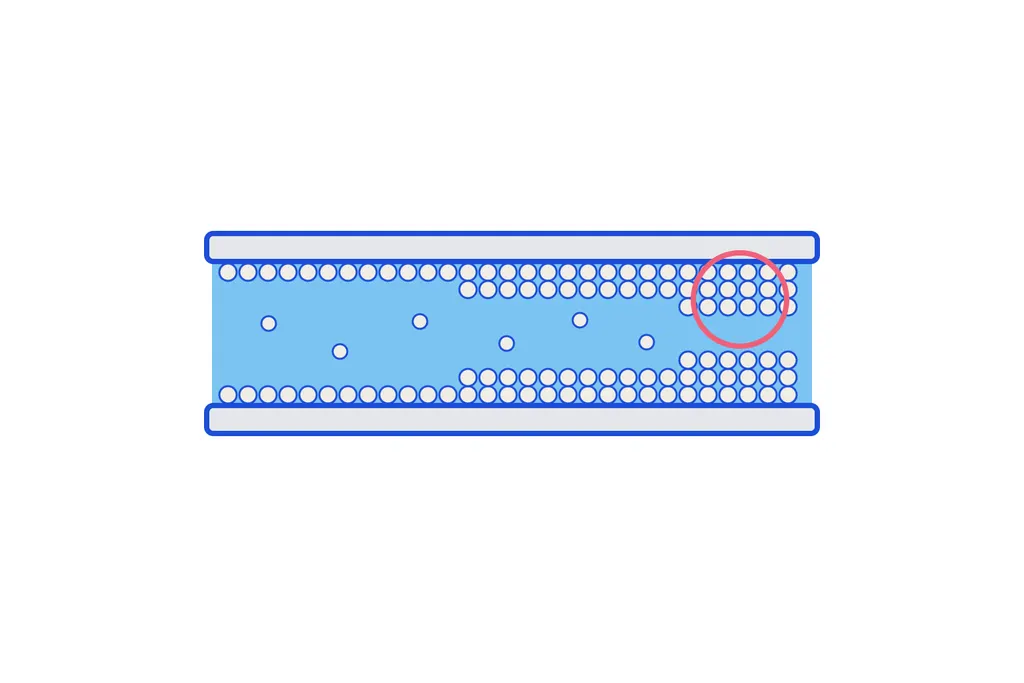
Trouble starts when the water is heated. USGS: “When hard water is heated, such as in a home water heater, solid deposits of calcium carbonate can form.” Over years, the same deposits can build up inside pipes. USGS says pipes “can gradually close up resulting in less water movement through the pipe and a lowering of water pressure.”
How common hard water is in the U.S.
It depends heavily on where you live and where your water comes from.
- Private wells. A USGS study of about 2,100 domestic wells in 48 states, sampled from 1991 to 2004, found that “Hard water (>120 mg/L as CaCO3) was found in about 60 percent of the sampled wells and was prevalent in the east-central and western United States.” USGS links that pattern to carbonate aquifers and aquifers with high dissolved solids. USGS notes the samples were “collected prior to in-home plumbing or treatment” and that the wells “may not be representative of all domestic wells throughout the United States.”
- The national map. The USGS national hardness map shows “Mean hardness as calcium carbonate at NASQAN water-monitoring sites during the 1975 water year.” USGS warns that “the 1975 data are not designed to be used to make local decisions or decisions on the scale of individual homeowner property.” It says local information should come from your local health agency, your water utility or a local water-softening vendor.
So a national map can’t tell you the hardness at your tap: USGS says its 1975 map isn’t meant for individual homes. We also found no official hardness dataset by ZIP code.
Signs of hard water at home
Agencies and extension services list these signs. Each one is a reason to measure, not proof:
| What you see | Who lists it |
|---|---|
| “Scaly residues, soaps don’t lather” | U.S. EPA, private well guide |
| “White/gray film, increased soap use, damaged hot water heater” | Penn State Extension, Testing Your Drinking Water |
| “whitish-gray residue when water is heated; decreased life of water heater elements; increased use of soap” | Penn State lab, hardness test description |
| Spots or film on glasses from the dishwasher, which USGS calls “hard-water residue” | USGS |
| Soap scum: “soap reacts with the calcium … to form ‘soap scum’” | USGS |
| Clothes that “may become dingy and gray with time,” spotted glassware, films on shower doors, walls and tubs | Nebraska Extension |
Scale also costs money. USGS says it “can reduce the life of equipment, raise the costs of heating the water, lower the efficiency of electric water heaters, and clog pipes.” The hard water vs soft water page compares what changes after softening.
Is hard water a health problem?
In its Water Science School summary of the domestic-well study, USGS writes: “Hardness is a property of water that is not a health concern, but it can be a nuisance.” That doesn’t tell you anything else about your water. Hardness says nothing about bacteria, lead, nitrate or other contaminants, and those need their own tests. For a city supply, start with your utility’s annual water quality report. For a private well, test through a state-certified lab. This site doesn’t give medical advice. For health questions about your water, ask your state or local health department.
How to find your hardness number
You need a number, not a guess. The Minnesota Department of Health says you can measure hardness “using a test kit or an independent laboratory.” If you’re on city water, you can also contact the water system directly.
- City water: community water systems must send customers an annual drinking water quality report (Consumer Confidence Report) each year by July 1, EPA says. Look for “hardness” in it. If it isn’t listed, ask the utility for the number in mg/L or gpg.
- Private well: Penn State Extension notes that no government program routinely tests private water systems for homeowners. A hardness test kit gives a quick reading. A lab can test hardness together with iron, manganese and pH, which also matter before you buy equipment.
Step-by-step options are on how to test water hardness, and kits and lab fees on water hardness test kits. Once you have the number, the Water Check shows its class on the Penn State Extension scale and whether a softener is worth considering.
Tool
Have a hardness number or a well test? Water Check turns it into what to install, the size and a price range.
Open Water CheckAn AI tool drew the illustrations on this page as simple diagrams. They are not photographs of real homes, water systems, products or people.
Sources
- USGS Water Science School — Hardness of Water (dated Aug 24, 2026)
- USGS — Circular 1332, Quality of Water from Domestic Wells in Principal Aquifers of the United States, 1991–2004 (DeSimone, Hamilton and Gilliom, 2009), pp. 5, 11 and 34
- Penn State Extension — Water Softening, Table 1 (updated Sep 8, 2025)
- Penn State Extension — Testing Your Drinking Water, Table 2 and testing responsibility (updated June 2, 2025)
- Penn State Agricultural Analytical Services Lab — Drinking Water Testing, individual analyses (checked Nov 1, 2026)
- U.S. EPA — Protect Your Home's Water, private wells (updated Feb 26, 2026)
- University of Nebraska–Lincoln Extension — G1491, Drinking Water Treatment: Water Softening (Ion Exchange) (revised Sept 2014)
- Minnesota Department of Health — Home Water Softening: Frequently Asked Questions (last updated Oct 3, 2022)
- U.S. EPA — CCR Information for Consumers (updated Nov 21, 2025)
Updated 2026-11-01